
The green city
The Urban Oasis Hiding Behind the Towers
The glass towers get photographed. The squares, street trees and public parks that make Sandton liveable rarely do. A look at the green precinct.
Search for an image of Sandton and you get the same photograph every time: a wall of glass towers at dusk, the Leonardo catching the last light, not a tree in frame. It is a true picture and a misleading one. The precinct that people actually move through is greener than its own publicity.
Johannesburg’s unlikely advantage
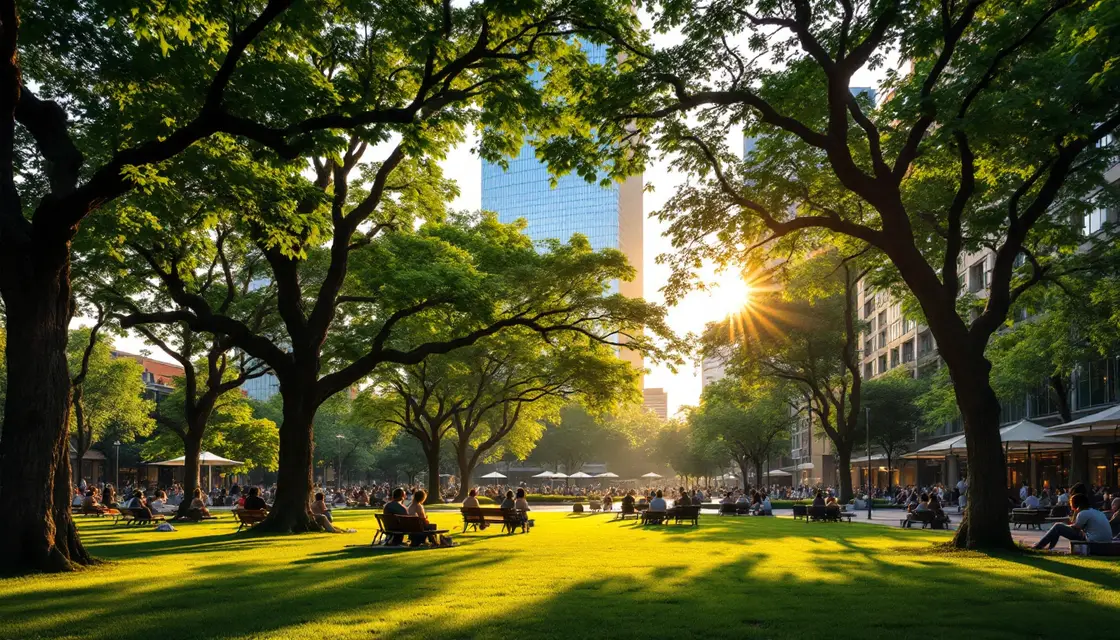
Start with the thing that surprises visitors. Johannesburg, Sandton included, is one of the most densely treed cities of its size anywhere, a planted urban forest laid down over more than a century. Fly in and the city reads green from the air long before it reads as a skyline. Sandton sits inside that canopy, which is why a street two blocks off the main drag feels less like a CBD than the towers suggest.
The squares do the quiet work
Inside Sandton Central the green is deliberate rather than accidental. The public squares and landscaped pedestrian routes between the main buildings are where the precinct does its quiet work: a place to take a call outside, eat lunch off the desk, or cross between meetings without touching a road.
These spaces rarely make the photographs because they are not trying to. They are the opposite of the skyline shot. They are the half of the design brief that makes the dense half bearable, and the precinct would be a far colder place without them.
The parks on the edge
Push to the edges of the precinct and the green opens up into proper public parks and open ground, the kind of landscaped escape that the lifestyle version of Sandton never mentions because it does not involve a rooftop bar. They matter more than the bars. A precinct that is only towers and restaurants is a place you tolerate; a precinct with somewhere to walk at the end of a day is a place you choose.
Why the oasis is the real story
The stereotype of Sandton is a cold concrete jungle, all ambition and no air. The stereotype is lazy. The precinct’s own designers spent decades threading green through the density precisely because the alternative does not work: nobody wants to spend their days, let alone live, inside an unbroken block of glass and tar.
So the urban oasis is not a marketing flourish laid over the business district. It is the thing that lets the business district function as somewhere people want to be. If you only know the towers, you are missing the part of Sandton that makes working from here a genuine choice rather than a sentence.
Common questions
Are there public parks near the Sandton CBD?
Yes. Alongside the landscaped public squares in Sandton Central, there are municipal green spaces on the edges of the precinct, and Johannesburg as a whole is one of the most heavily treed cities in the world.
Is Sandton walkable?
The Sandton Central core is walkable on foot between the main towers, squares and the Gautrain station. The wider precinct is more spread out and mixes walkable pockets with car-dependent stretches.
More from The Pulse
Food and culture
Lunch Under the Towers
How the precinct dines, from Nelson Mandela Square to the rooftops, without the tourist traps.

Working culture
Why Work From Sandton, Not From Home
The spare-room office won the lockdown and quietly stopped working. The honest case for the precinct.

Working culture
The Hybrid Work Network of the Precinct
How to work from the precinct without a lease: memberships, boardrooms, day passes and how to choose.